Coventry’s only 5-Star Rated scaffolding company
Is It Illegal to Work on a Roof Without Scaffolding?
Roofing work is dangerous, and there are rules designed to keep people safe while carrying out repairs. There are some circumstances in which working on a roof without scaffolding is legal, but the Work at Height Regulations 2005 have clear consequences, from fines to prosecution. The short answer is that you need scaffolding or another safety measure to work on a roof more than 2 metres high.
Commercial roofing activities have stricter regulations than domestic projects, but safety measures are always necessary. If you’re repairing your own roof, you aren’t bound by the same Health and Safety rules as employers, but safety precautions are still important to prevent falls or dropped tools injuring people below.
Roof Work Safety Regulations in the UK
Roof work is covered under the Work at Height Regulations 2005, which specifically address requirements for scaffolding. “Work at height” is defined as any work in which “a person could fall a distance liable to cause personal injury”. This includes working on a ladder, a flat roof or a fragile surface, or near an opening in a floor or hole in the ground. As a guide, two metres is high enough to cause injury.
Employers and contractors have a duty to:
- Avoid work at height if reasonable using extendable tools and assembling as much as possible at ground level
- Conduct risk assessments for unavoidable situations
- Use work equipment and safety measures to prevent falls
- Ensure workers can get to and from the height safely
- Follow safety precautions when using equipment such as scaffolding, elevated platforms and ladders
When Scaffolding Is Legally Required
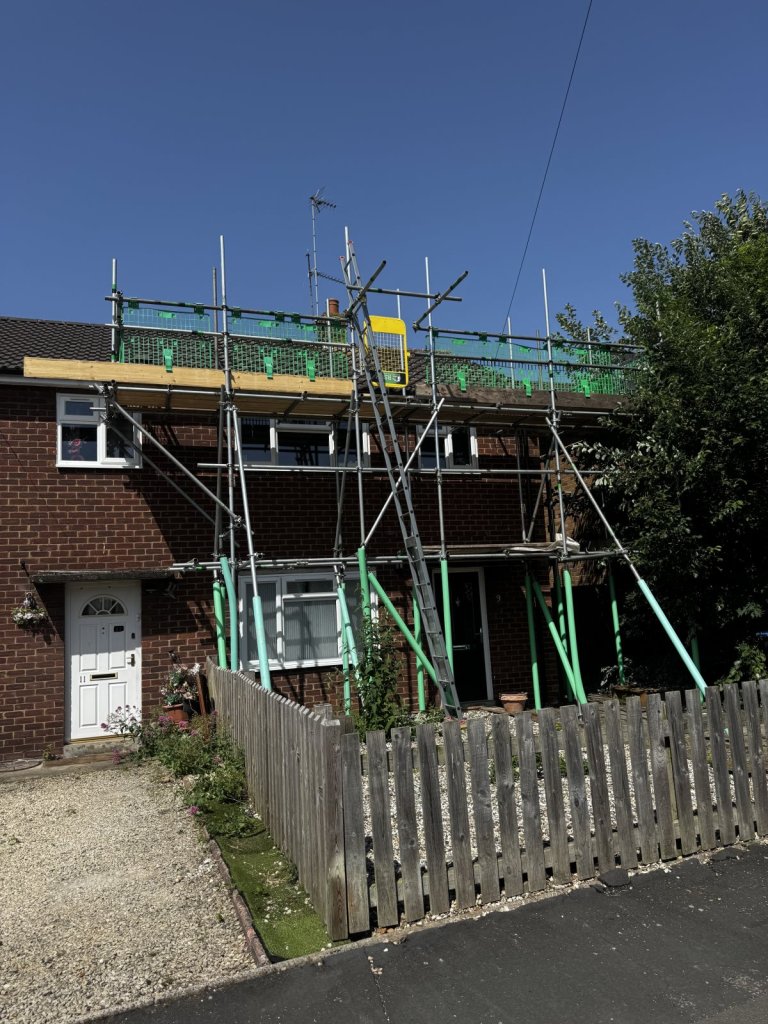
Suitable access equipment is legally required for any work involving a risk of falling, such as roof work over two metres high. Scaffolding provides a stable, secure area for work, preventing falls and injuries and stopping tools or roof tiles from falling.
For long term work on a roof, temporary roof scaffolding is the best solution. Insurance companies may require scaffolding for large jobs such as loft conversions and roof replacements.
To work on roofs of commercial buildings more than two storeys high, scaffolding is the only equipment that provides adequate support and prevents falls. Health and Safety Executive (HSE) guidance specifies that a flat concrete roof with a guardrail or walled edge does not constitute a fall risk, so doesn’t need scaffolding.
Exceptions and Alternative Safety Measures
There’s no situation in which scaffolding is the only mandated safety solution.
Alternative safety equipment may be used if it achieves equal or better control of fall risks, accounts for factors such as scale, duration and the nature of work and adheres to the same working at height regulations.
Scaffolding may not be best for a quick job, such as replacing a damaged tile, where it would be a disproportionate expense.
If a risk assessment determines that scaffolding is not required, you may be able to use ladders and edge protection, or safety harnesses. Mobile elevating work platforms (MEWPs) can also provide stability and prevent falls. In some cases, it may be appropriate to install safety nets and soft landing systems to prevent impact in the case of a fall.
However, these alternatives can have drawbacks. They may not afford workers the same confidence as scaffolding, slowing work. They may restrict the tools that can be used, or the numbers of people who can access the site. Consider these points when deciding whether or not your roofing job needs scaffolding.
Risks of Working on a Roof Without Scaffolding
Working at height is dangerous and regulated because of the serious risks to life it presents. Slips and falls from height can be fatal, and must be prevented at all costs with scaffolding, edge protection or harnesses. Falls are also a risk when the surface is fragile or unstable, such as a weakened roof after a fire or storm, and scaffolding can provide a stable support from which to work.
Falling objects are a danger to those on the ground, as even a small tool can gain momentum as it falls, increasing the force of impact. Edge protection such as toe boards on scaffolding reduces the risk of dropped items falling over the edge of the platform and injuring someone below. Securing tools and equipment properly is vital to prevent this.
Electrical hazards include overhead wires and improper cabling for power tools. Awareness of electrical hazards is a key part of the risk assessment for working at height and all staff should be thoroughly trained on electrical safety to prevent shocks or fires.
Financial and Legal Consequences
Beyond injury or fatality, there are legal consequences for inadequate safety equipment, ranging from fines, civil claims, insurance voiding and potential prosecution.
Fines can be up to £3,000 per offence, while prison sentences can be up to 2 years. The scale of penalties depends on the severity of the breach, the size of the company and the history of previous violations.
If an accident occurs because of unsuitable safety precautions, your insurance may become void, making compensation a big expense for the company. Contractors and homeowners may become liable if they insist on work taking place without scaffolding when it should be used.
You should also consider the reputational damage that could occur if roofing work is carried out without scaffolding and breaches health and safety regulations.
For employees, non-compliance with health and safety could lead to injury, but also disciplinary action, including dismissal, loss of earnings and potential prosecution.
Benefits of Using Scaffolding for Roof Work
While it is not illegal to work on a roof without scaffolding in some situations, such as DIY work, employers are legally required provide adequate safety measures for working on roofs or at height above 2m.
Scaffolding is an excellent solution for long-term roofing jobs, providing a stable, secure working platform.
The stability and safety offered by scaffolding also provides efficiency. It is faster to reach height than other methods, and once workers are at height they can move with relative ease and confidence. It is also easier access for tools and materials.
Compliance is a key priority for scaffolding companies, and all scaffolding provided is erected by experts to ensure it meets HSE and local council requirements.
With a reliable and regularly inspected scaffold, workers, property owners and commercial construction managers get peace of mind – a valuable asset.
Speak with RSUK Today
RSUK provides residential, commercial and industrial scaffolding throughout the West Midlands. Our team is experienced in creating risk assessments for working at height and can handle all permissions easily. For commercial scaffolding projects, our professional approach ensures safety and legal compliance, protecting employers. We carry this professionality in every job and make sure to respect homeowners’ access when putting up domestic scaffolding.
Get a quote for scaffolding to support roofing work: contact RSUK today.
WE ARE RSUK
Related Blogs
RSUK is a reputable scaffolding business based in Coventry. We serve customers in Leicester, Birmingham, Coventry, and the surrounding areas.