Coventry’s only 5-Star Rated scaffolding company
How to Erect Scaffolding Safely in the UK
Scaffolding is required for any kind of construction or maintenance project, and it must be erected properly and safely. Safe scaffolding erection involves careful planning, the proper equipment choice and trained professionals. Hiring the right scaffolding provider can mean the difference between a stable, secure work platform and compliance issues, site hazards and more.
In this guide, we’re going to cover how to erect scaffolding, the UK’s scaffolding regulations, some top safety tips, whether you can erect your own scaffolding and how to hire a professional contractor for scaffolding erection.
What are the UK Scaffolding Regulations?
In the UK, scaffolding erection is governed by three core pieces of legislation and sets of regulations:
- The Work at Height Regulations
- The Construction (Design and Management) Regulations
- The Health and Safety at Work Act
The simplest way to ensure compliance with these, according to the HSE, is to follow National Access and Scaffolding Confederation (NASC) Safety Guidance SG4 ‘Preventing falls in scaffolding operations’.
The HSE also states that ‘Scaffolds must be designed, erected, altered and dismantled only by competent people and the work should be carried out under the direction of a competent supervisor.’
There are different types of scaffolding including domestic, commercial and industrial, each of which requires a unique approach and bespoke design.
You can learn more about the UK’s scaffolding regulations in our blog post.
Scaffolding Erection: Step-by-Step
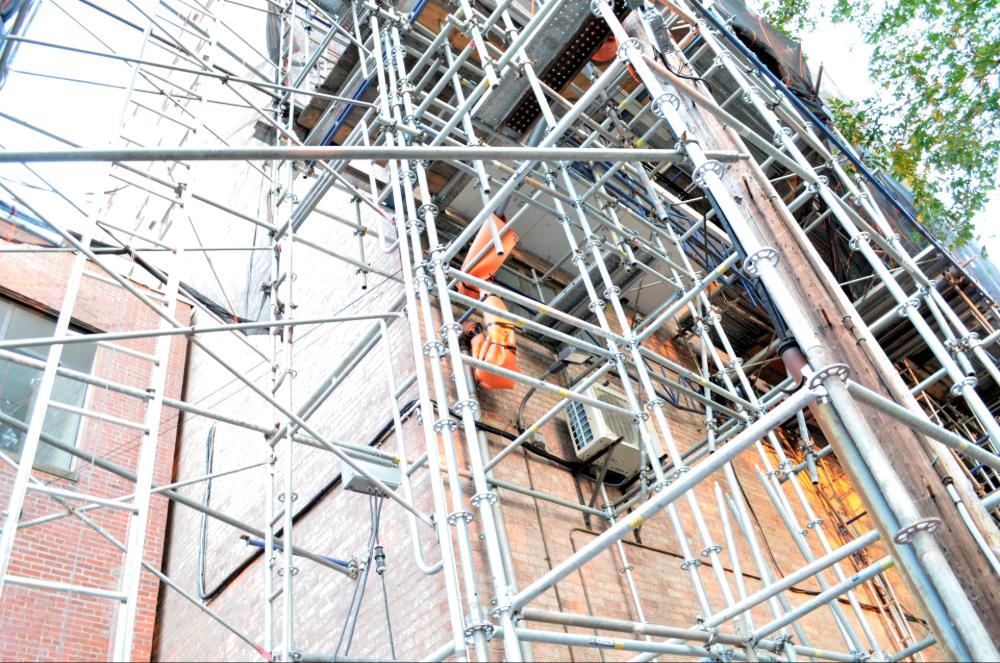
In general, erecting scaffolding involves seven distinct steps, each designed to ensure a safe, secure platform. These include:
1. Site Assessment
Before any scaffolding work can start, the site will need to be thoroughly inspected. Your scaffolding team will assess the area for access points, terrain gradient and stability and any overhead obstructions.
2. Install the Foundations
The first step in the scaffolding erection process is to install the foundations. Base plates will be placed on suitable ground, often with sole boards to help spread the load of the structure and prevent settlement. Standards will then be installed onto the foundations, providing a secure base capable of supporting the weight of the scaffold, workers and materials.
3. Secure With Bracing
Next, diagonal braces and ties are installed. This strengthens the structure and prevents movement. Braces make the scaffolding more rigid, while ties attach it to the building where necessary. Together, these components allow the scaffolding to resist wind stress and maintain stability.
4. Lay Scaffold Boards
Once the framework is complete, scaffold boards can be laid to create working platforms. The boards will need to be properly supported, spaced and positioned to prevent movement.
5. Add Security Features
With the platforms in place, the structure is then fitted with a range of safety features to protect workers and reduce the risk of falls. These usually include guardrails and toe boards. Scaffolds may also be fitted with brick guards and debris netting, depending on the project.
6. Include Access Points
It’s critical that workers can safely access the scaffold throughout your project. To enable this, clear access points will be installed. Access points include fixtures such as ladders, ladder access bays and scaffold stair towers. All these routes will need to be unobstructed and allow workers to move safely between levels.
7. Final Inspection
Finally, before the scaffold is opened for use, it will need to be thoroughly inspected by a competent person. This person will check that all components have been installed correctly and that the scaffold is stable and ready for workers. They will also ensure that the scaffold has been installed in accordance with key safety guidelines, including the scaffolding 3-to-1 rule.
Scaffolding Erection Safety Tips
Here are our top five tips for safely erecting scaffolding:
1 – Thorough Site Assessment
Every scaffolding erection should begin with a thorough site assessment. This ensures your scaffold is built on secure, level ground and that there are suitable access points for workers and materials.
2 – Ensure Only Competent Personnel Erect Scaffolding
The HSE states that scaffolding should only be erected by competent personnel, and it’s critical that this guidance is followed. You should always use qualified scaffolders to erect your scaffolding.
3 – Use Suitable Protection
Wherever there is a risk of falling, suitable fall protection should be used in line with your risk assessment and method statement. It is important to always wear a hard hat and high vis for additional safety when erecting scaffolding and throughout the project.
4 – Keep Access Routes Safe
Access routes such as ladders and stair towers must be installed correctly and kept clear of tools, materials and debris.
5 – Inspect Before Use
Scaffolding should be inspected by a competent person before use, after any alterations or heavy weather and at regular intervals, in line with the Work at Height Regulations.

Can I Erect My Own Scaffolding?
Unless you are suitably qualified, you should not erect your own scaffolding. The HSE states that scaffolding should only be erected by ‘competent people’ and under the direction of a ‘competent supervisor’.
Without proper training, an unqualified person might make critical mistakes, including:
- Building on unstable ground
- Not using enough or the correct type of bracing
- Failing to tie scaffolding to the structure
- Creating unsafe access
- Overloading the scaffolding
- Omitting guardrails and toe boards
- Ignoring height-to-base stability requirements
Full legal requirements for erecting scaffolding are laid out in the Work at Height Regulations 2005. Any scaffolding that’s built over public land or highways will also require a licence. You can learn more about scaffolding licenses and the laws surrounding permission for scaffolding outside your home.
Hire a Professional Contractor for Scaffolding Erection
Hiring a professional contractor is critical for the success of your scaffolding project, both from a safety and stability perspective and for legal compliance. At RSUK, we are a NASC-approved scaffolding contractor with more than 40 years of experience in scaffolding erection, dismantling and much more.
We work with all kinds of scaffolding, including commercial, domestic and industrial, and offer bespoke structures to suit any requirement. To discuss our scaffolding services, or for any questions, just contact our team now on 0121 820 3456, email us at enquiries@rsuk.org.uk or fill out our contact form.
WE ARE RSUK
Related Blogs
RSUK is a reputable scaffolding business based in Coventry. We serve customers in Leicester, Birmingham, Coventry, and the surrounding areas.