Coventry’s only 5-Star Rated scaffolding company
What Is Temporary Roof Scaffolding?
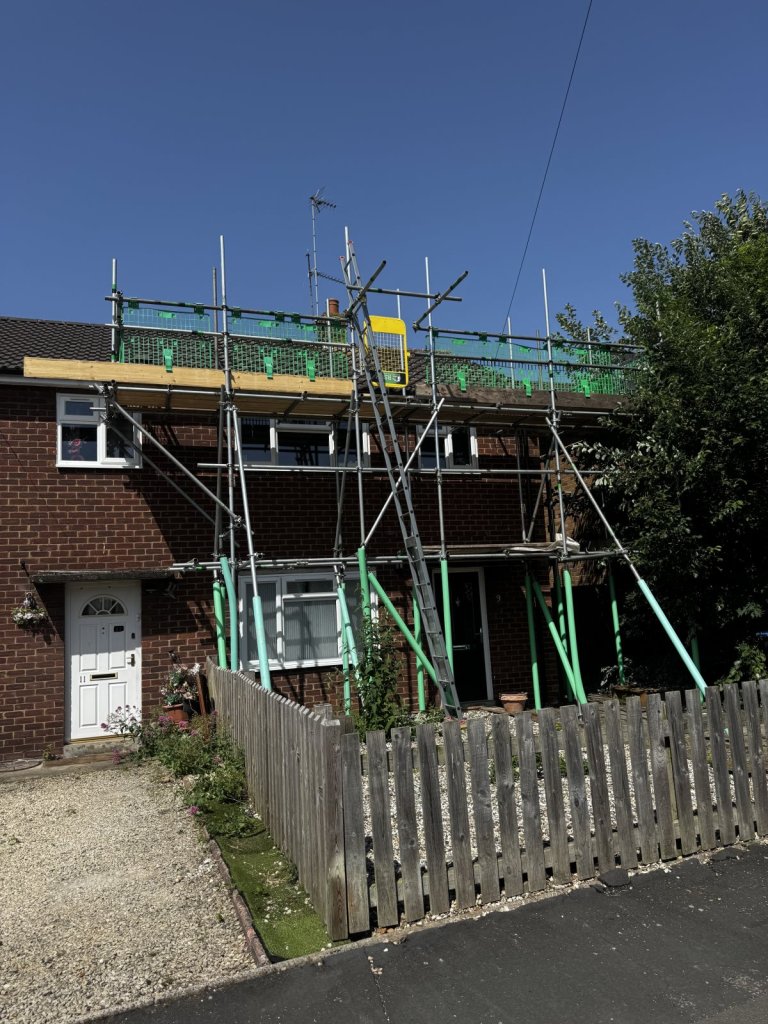
Temporary roof scaffolding is a protective structure used in commercial, industrial and domestic settings. It is a standard scaffolding set up with sheeting draped over the top to create a temporary roof. This is crucial in protecting equipment and keeping the work area dry and secure from the elements.
They are typically used during roof repairs, loft conversions and chimney repairs. Temporary roof scaffolding is also crucial to protect sensitive areas inside the property. This is a highly customisable, versatile and flexible protective system that can be used in various situations.
Why Temporary Roof Scaffolding Is Important for Construction Projects
Temporary roof scaffolding is one of the most essential tools for construction projects as it protects workers and the structure itself from adverse weather, allowing work to continue without delays. It shields materials from rain and wind, preventing damage and reducing costly repairs or replacements. Safety is also greatly improved as the scaffolding provides stable platforms and helps contain debris, lowering the risk of accidents.
Making use of temporary roof scaffolding creates a controlled environment that boosts productivity and ensures consistent work quality. It helps maintain project timelines and avoids disruptions due to weather. Overall, it is an important and smart investment that enhances safety and efficiency on construction sites.
How Temporary Roof Scaffolding Works
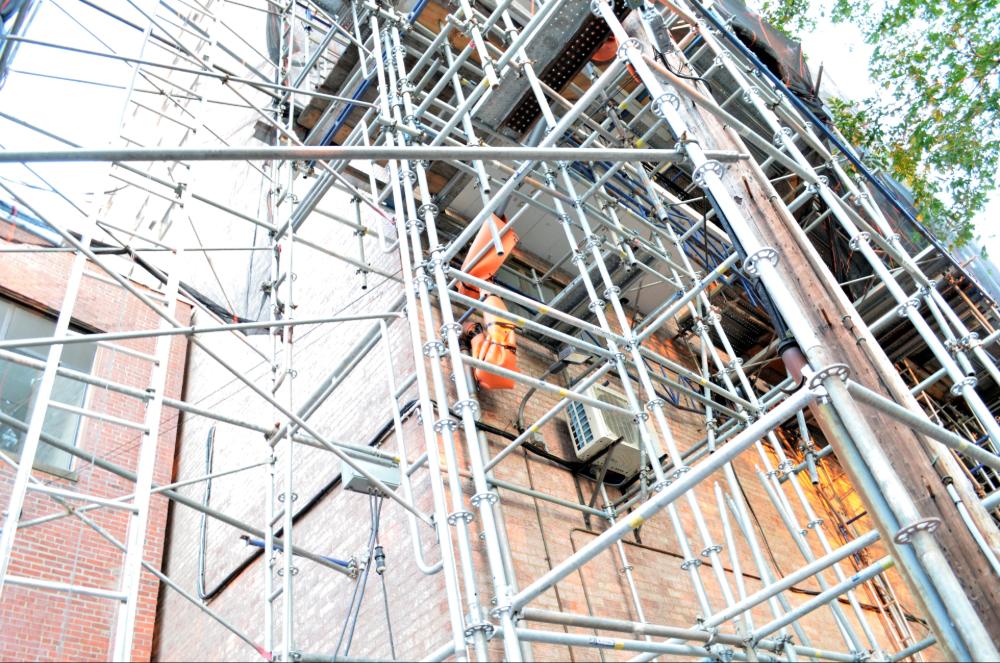
Temporary roof scaffolding is a protective structure used on construction sites to shield workers and buildings from the weather during repairs or renovations. It typically consists of a framework made from steel or aluminium tubes, connected via clamps and couplers. The roof covering is usually made of durable, weather-resistant sheeting or tarpaulin, supported by trusses or beams.
Assembly will begin by constructing the base scaffolding around the building. Once the structure is fully stabilised, roof trusses are added, followed by the installation of whatever covering material will be best to use. For larger spans, cranes are often used to assist with lifting and placement.
This type of scaffolding system is modular, making it adaptable to various building shapes and sizes. Its flexibility and strength make it ideal for temporary protection, whatever the project. After the work is completed, the temporary roof and scaffolding are dismantled in reverse order and safely removed from the site.
Key Components of a Temporary Roof Scaffold
The key components of standard temporary roof scaffolding include:
- Standards, otherwise known as vertical poles
- Ledgers, otherwise known as horizontal tubes
- Transoms, which are the supporting cross-sections
- Roof frames that can be flat or pitched, depending on the structure below
Each structure will be connected with clamps and couplers that will create a solid and sturdy foundation for the roof. The roof itself can be made from waterproof sheets, tarpaulin, corrugated steel and shrink wrap.
Types of Temporary Roof Scaffolding Systems
Although adaptable, scaffolding systems can be categorised in three ways.
Covering material
The covering material is simply what the roof is made from. The common options are a sheeting system that uses weatherproof materials like PVC, shrink-wrap or polythene. Or, a rigid system that uses metal sheeting, either aluminium, steel or composites.
Configuration
Tented or canopy scaffolding is a general term given to configurations that feature a roof ranging from a full-building enclosure to a targeted section over a skylight.
Structural approach
- There is tube fitting that can be built from the ground up, creating bespoke designs
- System scaffolding has pre-fabricated parts that connect quickly
- Frame scaffolding has fully pre-fabricated frames that require little to no set-up
Advantages of Using Temporary Roof Scaffolding
- Weather protection: The immediate advantage of setting up a temporary roof is that it will keep out the various elements that can affect work rate. This will keep the work area and materials dry, cutting down on delays and extra expenditure
- Efficiency: The efficiency of the site will remain on track as materials, completed work and the team will remain dry
- Safety: The roof will stop the internal surface from becoming slippery, which is a leading cause of site accidents
- Adaptability: Being modular in design means they can be fitted into virtually any space
Safety and Compliance Requirements
At RSUK, we bring over 40 years of scaffolding expertise across domestic, commercial and industrial sectors. Safety is our number one priority, from proper equipment and load limits to licensed builds and weather checks.
We follow UK regulations, including National Access and Scaffolding Confederation TG20:21, and promote regular inspections and responsible access. Our skilled, Construction Industry Training Board (CITB) and Construction Skills Certification Scheme (CSCS)-certified team ensures compliance and structural integrity on every job with responsible working and up-to-date training practices.
Regardless of size, location or scenario, we deliver safe, reliable scaffolding solutions at affordable prices.
Choosing The Right Scaffolding Company
Correctly constructing scaffolding is as important as the work it will be used for. For safety compliance and convenience, it pays to choose a trusted scaffolding company. RSUK has over 40 years in the industry with comprehensive services and an experienced team of qualified professionals.
We can tackle any size and complexity of job with our state-of-the-art design software that has made us the leading West Midlands scaffolding company. If your job is going to require temporary roof scaffolding or just scaffolding in general, contact us or get a quote and let’s work out a plan perfect for your project.
WE ARE RSUK
Related Blogs
RSUK is a reputable scaffolding business based in Coventry. We serve customers in Leicester, Birmingham, Coventry, and the surrounding areas.