Coventry’s only 5-Star Rated scaffolding company
Different Types of Scaffolding and Its Uses
Scaffolding is a crucial part of almost any construction, renovation or elevated maintenance task. But there are different types of scaffolding, each used for various circumstances and with its own set of advantages and drawbacks. For example, you might use a different system depending on whether you’re working on domestic, commercial or industrial sites.
In this blog post, the experts at RSUK break down some of the different types of scaffolding as well as how to choose the right one for your project.
Keep reading to learn more, or for a free scaffolding quote, just call us now on 0121 820 3456.
What Is Scaffolding?
Scaffolding is a temporary platform structure used to allow site workers to access elevated locations around a building. It’s used for construction, renovation and maintenance tasks. Scaffolding comes in various types, as we’re about to cover, but is almost universally constructed from networks of poles held together with brackets or connectors of some kind.
Common components in most scaffolding systems include standards, bracing, base plates, ledgers, transoms and couplers.
In the UK, the erection and maintenance of scaffolding is governed by strict guidelines and legislation. Scaffolding must be installed by a professional scaffolding contractor and be inspected regularly during use.
Common Types of Scaffolding Systems
So, what are the different types of scaffolding? There are a few different types used across the UK, depending on the location, site and project. Each variation has its own upsides and downsides, and knowing these is key to understanding which type you should choose for your project.
For example, you’re likely to opt for a more mobile solution for simple maintenance tasks such as painting, while something like supported scaffolding is more suitable for larger projects or more long-term work.
Supported Scaffolding
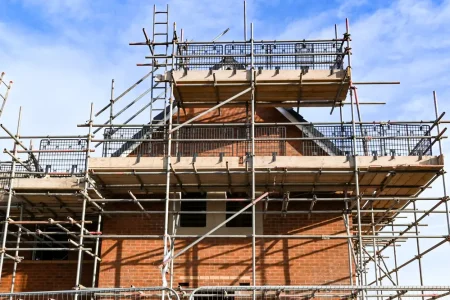
Supported scaffolding is a bracket of scaffolding types that includes a selection of different setups. It features those varieties of scaffolding that are built from the ground-up, using a floor-mounted base as their primary support. This includes frame, ladder jack, mast climber, mobile, trestle and tube and coupler scaffolding.
These types of scaffolding are a favourite for a range of project types, as they’re straightforward to set up. Supported scaffolding systems are erected using just a handful of components, making material planning easy. They’re also relatively simple to install, maintain and dismantle.
The primary drawback, however, of supported scaffolding is the requirement for a solid base with plenty of room. This is fine on larger, level sites, but can be a challenge in more restricted areas or where the ground around a building is sloped or not solid.
Suspended Scaffolding
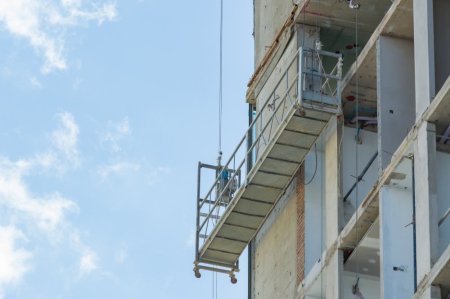
Rather than relying on a base on the floor, suspended scaffolding systems are hung from above. Using wires or cables, suspended scaffolding platforms are able to be moved up and down from a rooftop, giving workers access to parts of a building that would otherwise be very difficult to reach.
Suspended scaffolding is usually used for particularly tall buildings, where extreme elevations would make traditional scaffolding physically or financially impractical.
The disadvantages of suspended scaffolding though are restricted horizontal reach and weight limits. Workers will only be able to access the part of the building covered by the platform they’re standing on, so large projects may require multiple platforms. Suspended scaffolding is also hoisted up and down by motors, which are designed for specific weight limits. If your task involves especially heavy materials, the weight could exceed these limits and create challenges.
Mobile Scaffolding
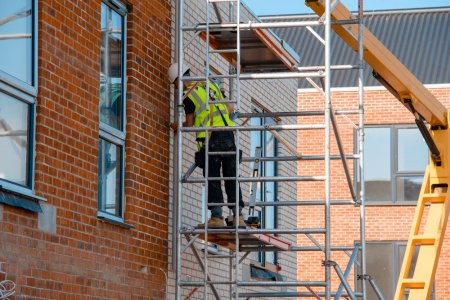
Mobile scaffolding towers are designed to be moved around a site, allowing workers to access different parts of a structure as needed. This type of scaffolding will often include wheels to allow for ease of relocation, with rigid braces to hold it in place while in use.
The advantages of this are pretty obvious, especially when you consider tasks like cleaning windows or repainting sections of a building’s exterior. The scaffolding can simply be moved to wherever the workers need to be.
On the other hand, mobile scaffolding is not suitable for uneven ground and the need to be mobile naturally limits the size of the scaffolding, as it must be small enough for workers to move. Because these systems are mounted on wheels, they also have weight limits, making them unsuitable for tasks with heavy materials or tools.
Trestle Scaffolding
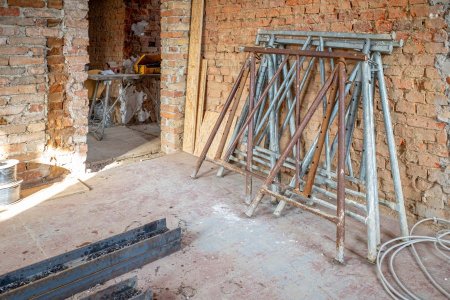
One of the simplest forms of scaffolding, trestle scaffolding, is made up of a platform supported by a series of A-frames. These frames are normally steel, and are delivered to a site pre-assembled and ready for installation. Alternatively, smaller trestle scaffolds can be supported by step ladders, making them very easy to design and install.
Trestle scaffolds are perfect for performing short-term maintenance tasks, and can be assembled using easily transported, common materials and tools. They can also be fitted with safety equipment such as railings and gates.
However, their simple construction also limits trestle scaffolds to smaller heights. They are rarely erected above 5m, and are not suitable for longer term projects or work with heavy materials or tools.
How to Choose the Right Scaffolding Type for Your Project
Narrowing down the different types of scaffolding and choosing the right variety for you involves evaluating the specifics of your project and site. For example, if you’re working at considerable elevation, a suspended scaffolding might be more suitable. If your project is more long term and requires large numbers of personnel and heavy materials, a supported scaffold may be better. Or, if you need to be able to move your scaffolding around a building, you could use a mobile scaffold.
In any case, scaffolding must be erected by a trusted, registered scaffolding contractor, who will be able to provide expert support on which type is most likely to meet your specific needs.
Speak With an Expert
Whatever your project or site specifications, the team at RSUK can recommend, install and maintain the perfect type of scaffolding. For more than 40 years, we’ve been serving clients across the West Midlands. We’re one of the region’s only five-star scaffolding contractors, and we employ a team of highly trained, friendly scaffolders with a wealth of industry experience.
We use state-of-the-art software to design and plan every scaffold, ensuring quick, efficient installation. Our expert team will also routinely inspect and maintain your scaffold for the duration of your project, ensuring seamless legal compliance throughout.
For a free scaffolding quote, get in touch now by calling 0121 820 3456, emailing enquiries@rsuk.org.uk or filling out our contact form.
WE ARE RSUK
Related Blogs
RSUK is a reputable scaffolding business based in Coventry. We serve customers in Leicester, Birmingham, Coventry, and the surrounding areas.